Curriculum
- 4 Sections
- 67 Lessons
- Lifetime
Expand all sectionsCollapse all sections
- I Basic information regarding dyslexia16
- 2.1History of Dyslexia
- 2.2Defining dyslexia 1/1
- 2.3Defining dyslexia 1/2
- 2.4What is dyslexia? 2/1
- 2.5What is dyslexia? 2/2
- 2.6What is dyslexia? 2/3
- 2.7Prevalence of dyslexia
- 2.8Reading Instruction
- 2.9The Five Components of good reading 3/1
- 2.10The Five Components of good reading 3/2
- 2.11Assessment – How is your student doing in reading?
- 2.12Ways to compensate poor reading and writing
- 2.13Causes of dyslexia
- 2.14When to use the term “dyslexia”
- 2.15Facts about persons with dyslexia
- 2.16The basics of dyslexia60 Minutes10 Questions
- II Identification of students with dyslexia19
- 3.1Introduction
- 3.2In which areas do students with dyslexia have difficulties?
- 3.3Reading difficulties
- 3.4Writing difficulties
- 3.5Problems with numbers and mathematical concepts
- 3.6Speech and language problems
- 3.7Problems with memory and behavior
- 3.8Data processing problems
- 3.9Defense mechanisms
- 3.10Identification of dyslexia
- 3.11Steps for dyslexia identification
- 3.12Step 1. Observation and recording
- 3.13Step 2. Interview with the student
- 3.14Step 3. Application of general strategies
- 3.15Step 4. Informing the parents
- 3.16Informing the parents 1/1
- 3.17Step 5. Including the special educator and rehabilitator as additional support
- 3.18Step 6. Support outside of the school
- 3.19Identification of students with dyslexia60 Minutes10 Questions
- III Work strategies for children with dyslexia19
- 4.1Introduction
- 4.2What we must not say to a child with dyslexia
- 4.3Accommodations for support of students with dyslexia 1/1
- 4.4Accomodations for support of students with dyslexia 1/2
- 4.5Accomodations for support of students with dyslexia 1/3
- 4.6Accomodations for support of students with dyslexia 1/4
- 4.7Work strategies for students with dyslexia 2/1
- 4.8Work strategies for students with dyslexia 2/2
- 4.9Work strategies for students with dyslexia 2/3
- 4.10Work strategies for students with dyslexia 2/4
- 4.11Work strategies for students with dyslexia 2/5
- 4.12Orton-Gillingham Approach
- 4.13The Mesezene method
- 4.14Let’s use ICT to help people with dysexia
- 4.15Lecture modifications according to Levine (1987, 1993)
- 4.16Techniques for auditive learners
- 4.17Techniques for students with difficulties with texts and writing
- 4.18Techniques for easier reading
- 4.19Techniques and tools for working with students with dyslexia60 Minutes10 Questions
- IV Psychological condition of students with dyslexia17
- 5.1Psychological impact of dyslexia
- 5.2Psychological condition of students with dyslexia
- 5.3Why is dyslexia frustrating and discouraging?
- 5.4How do students with dyslexia feel?
- 5.5Low self-esteem and frustrations
- 5.6Anxiety
- 5.8Depression
- 5.9CONCLUSION
- 5.10Self – esteem
- 5.11MANIFESTATION OF LOW SELF – ESTEEM
- 5.12SELF CONFIDENCE AND SCHOOL CONCEPTION
- 5.13Improving self – confidence
- 5.14How to help a student with low self-esteem?
- 5.15What can you do about it? 1/1
- 5.16WHAT CAN YOU DO ABOUT IT? 1/2
- 5.17WHAT CAN YOU DO ABOUT IT? 1/3
- 5.18Psychological state of students with dyslexia60 Minutes10 Questions
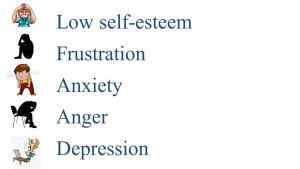
How do students with dyslexia feel?
According to the research, in addition to the problems arising from dyslexia itself, people, especially students with dyslexia, most often face the following emotional states.